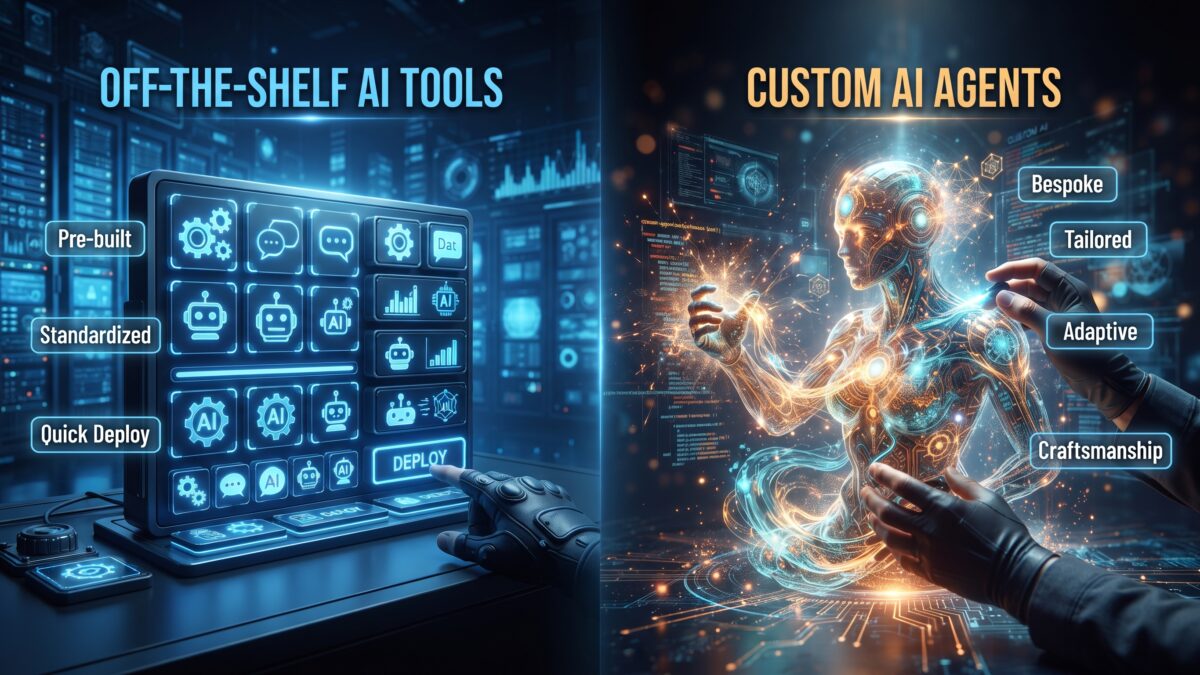
Somewhere in your company right now, a team is quietly paying for an AI tool that nobody remembers approving. Maybe it’s a chatbot plugin. Maybe it’s a “smart” add-on bolted onto your CRM. The average business today runs dozens of AI subscriptions across departments, and most of them were never evaluated against a real alternative. They were just the fastest thing to click “subscribe” on.
That’s how most companies end up choosing between custom AI agents and off-the-shelf AI tools by accident instead of on purpose. And it’s an expensive way to make a decision that, done right, can either compound into a genuine competitive advantage or quietly drain your budget for two years before anyone admits the project isn’t working.
This guide is built to stop that from happening to you. No hype, no vendor pitch, just a grounded look at what each path actually costs, where each one breaks, and a practical framework you can use this week to decide which one fits your business.
The Short Answer, If You’re in a Hurry
If your workflow is common, well-defined, and shared by thousands of other companies (email drafting, meeting notes, basic customer support triage), buy. A vendor has already solved that problem better than your internal team will in the next six months.
If your workflow depends on proprietary data, a regulated process, or a decision logic that gives you a real edge over competitors, and you have the engineering capacity to maintain it, building a custom agent is usually worth the investment.
Most companies that get this right don’t pick one lane. They buy the commodity layer and build only where it’s genuinely strategic. We’ll walk through exactly how to tell the difference.
What Are We Actually Comparing Here?

Before going further, it helps to be precise about the two things on the table, because the term “AI agent” gets used loosely.
Custom AI agents
A custom AI agent is a system built specifically for your business: your workflows, your data, your compliance requirements, and your edge cases. It typically combines a large language model with retrieval systems, internal APIs, and orchestration logic that lets it plan, take actions, and complete multi-step tasks with limited human input. You (or a development partner) own the architecture, the source code, and the operational stack. Nothing about it is generic.
Off-the-shelf AI tools
An off-the-shelf AI tool is a pre-built product designed to solve a common problem for a wide range of businesses at once. Think of a SaaS platform with an AI feature baked in, or a ready-to-deploy AI agent you configure through a dashboard rather than code. You’re renting capability, not owning infrastructure, and the vendor decides the roadmap.
Think of it the way you’d think about clothing. An off-the-shelf tool is a well-made suit off the rack. It fits most people reasonably well and gets you into the room today. A custom agent is a tailored suit, cut to your exact measurements, built for a specific occasion, and useless to anyone else.
Why This Decision Is Suddenly Unavoidable in 2026

This isn’t a theoretical debate anymore. The market has exploded to the point where avoiding the decision is itself a decision, and usually the wrong one.
Depending on which analyst firm you ask, the global AI agents market sits somewhere between $9 billion and $12 billion in 2026, and every major research house expects it to grow at a compound annual rate somewhere between 40% and 50% for the rest of the decade. Gartner’s own projection is that task-specific AI agents will show up in 40% of enterprise applications by the end of this year, up from under 5% just two years ago. The numbers vary because “agentic AI” means different things to different analysts, but the direction is not in dispute.
At the same time, adoption has outpaced governance in a way that should worry any leadership team. Gartner has found that a large majority of enterprises already use AI agents in some form, yet fewer than half have formal security policies covering them. Separate research found that a striking share of companies have already had an AI agent take an unintended action, including reaching systems or data it wasn’t supposed to touch.
There’s also a quieter cost bleeding through the budget: tool sprawl. The average company now juggles hundreds of SaaS applications, and AI subscriptions are the fastest-growing category inside that mess. Industry tracking suggests the typical business now runs multiple dedicated AI tools that finance never formally signed off on, with monthly AI spend climbing sharply year over year. Every one of those tools is an unmanaged doorway into your data.
In other words, the “should we just add another AI tool” question isn’t free anymore. It has a real, measurable cost attached, whether you build or buy.
The Case for Off-the-Shelf AI Tools

Let’s give credit where it’s due, because buying is the right answer more often than engineering teams like to admit.
Speed to value. A vendor platform can be live in days, sometimes hours. There’s no hiring cycle, no infrastructure to stand up, and no six-month build before you see a single result.
Lower upfront cost. Subscription pricing usually runs from a few hundred to a few thousand dollars a month depending on usage, a fraction of what a custom build costs before it produces anything.
Someone else owns the hard problems. Model updates, security patching, uptime, and compliance certifications are the vendor’s job, not yours. You’re not competing for scarce AI engineering talent to keep the lights on.
Proven at scale. A mature vendor has already handled the edge cases you haven’t thought of yet, because thousands of other customers hit them first.
Faster path to a real ROI number. Recent industry data points to a median payback period of roughly five months for bought AI tools, which is a number most CFOs can plan around confidently.
Where Off-the-Shelf Tools Hit a Wall

The cracks show up the moment your workflow stops looking like everyone else’s.
Rigidity. Pre-built tools are designed for the average use case, and the more specialized your process, the more you find yourself reshaping your workflow to fit the software instead of the other way around. That’s automation working backward.
Data and security limits. If your data can’t leave a defined security perimeter, or if a regulator requires an audit trail the vendor’s architecture wasn’t built to produce, no amount of configuration will fix that.
Customization fees eat the savings. It’s common for a business to buy a platform for its low sticker price and then spend hundreds of thousands of dollars customizing it to handle workflows the vendor never designed for, which quietly erases the cost advantage that justified buying in the first place.
Vendor lock-in. The deeper a bought platform gets woven into daily operations, the more expensive it becomes to leave. Switching costs are invisible on the original pricing sheet and very visible three years later.
Not every vendor is what it claims to be. Analysts estimate that of the thousands of companies marketing themselves as agentic AI vendors, only a small fraction offer genuinely autonomous systems. The rest are applying an AI label to what is still fairly conventional automation, sometimes called “agent washing.”
The Case for Custom AI Agents

Now the other side of the ledger, because building is not just ego or over-engineering. There are real, defensible reasons to do it.
Your data becomes your moat. A generic vendor tool is trained to work for everyone, which means it’s optimized for no one in particular. A model built on your historical transactions, your proprietary documents, or your specific customer behavior can outperform any general tool on the exact problem that matters most to your business. Research from McKinsey has found that companies that excel at personalization generate roughly 40% more revenue from those efforts than average performers, and that kind of edge is almost impossible to buy off a shelf.
Full control over architecture and governance. You decide where data lives, how the agent reasons, what it’s allowed to touch, and how it’s audited. For regulated industries like healthcare, finance, or legal services, that control isn’t a nice-to-have, it’s often the only way to stay compliant.
No ceiling on customization. A custom agent can be shaped around a workflow that has never existed anywhere else, because it was built for exactly that workflow.
Real transformation, not surface-level productivity gains. Deloitte’s most recent enterprise AI survey of 3,000 business leaders found a sharp split: roughly a third of companies are still using AI for basic productivity tasks like chatbots and summaries, while a smaller group is using it to fundamentally redesign how they operate. That second group, according to the same research, reported meaningfully higher revenue growth and lower capital costs than the first. The pattern is consistent across the data: shallow AI use produces shallow results, and the deeper gains tend to go to the companies willing to build something specific to how they actually work.
The Hidden Costs of Building Custom

Here’s the part vendors won’t tell you and engineering teams sometimes underestimate.
It costs more than the quote. A single enterprise-grade custom agent typically runs anywhere from $75,000 to $500,000 for the initial build, and complex systems with heavy governance and integration requirements can exceed $800,000. Annual maintenance then adds another 15% to 25% of that build cost, every year, indefinitely.
Most pilots never make it to production. Independent research covering hundreds of public AI deployments found that a striking share of enterprise generative AI pilots never deliver a measurable financial return. Separate data shows purchased AI solutions succeed roughly twice as often as internally built ones, largely because vendors have already solved problems that internal teams are encountering for the first time.
Talent is scarce and expensive. Building requires specialized skills in retrieval-augmented generation, orchestration, evaluation, and model behavior that most internal teams don’t already have, and every engineer working on the agent is an engineer not working on your core product.
Data preparation eats the timeline. In many custom builds, cleaning and structuring data alone consumes up to 80% of total project effort before a single meaningful feature ships.
The failure rate is not a rounding error. Analysts at Forrester have projected that a majority of companies attempting to build their own agentic systems from scratch will fail, largely because of the combined complexity of multiple models, data architecture, and specialized expertise required to do it well. Gartner has separately projected that more than 40% of agentic AI projects currently underway will be canceled before the end of 2027, mostly due to spiraling costs and unclear business value.
None of this means building is a bad idea. It means building without a plan is a bad idea, which is exactly what the framework below is designed to prevent.
Custom vs Off-the-Shelf: Side-by-Side
| Factor | Off-the-Shelf AI Tools | Custom AI Agents |
|---|
| Time to first value | Days to weeks | Three to twelve months, often longer |
| Upfront cost | Low (subscription-based) | High ($75K to $800K+ for enterprise-grade builds) |
| Ongoing cost | Scales with usage and seats | 15% to 25% of build cost annually |
| Customization ceiling | Limited, configuration-based | Unlimited, built around your exact workflow |
| Data ownership | Shared with vendor | Fully owned internally |
| Security and compliance control | Vendor-defined | Fully customizable to your requirements |
| Talent required | Minimal | Specialized AI/ML engineering team |
| Vendor lock-in risk | High over time | None, but internal dependency risk instead |
| Best fit | Common, well-defined workflows | Proprietary, regulated, or differentiating workflows |
| Failure risk | Lower, proven at scale | Higher without disciplined scoping |
What It Actually Costs: A Real Numbers Breakdown

Cost comparisons that stop at “build costs more upfront” miss the point entirely. The number that actually matters is total cost of ownership over three years, because that’s roughly how long most companies keep either choice before revisiting it.
A custom build carries a large capital cost in year one and then comparatively modest, though not negligible, ongoing costs. An off-the-shelf platform carries a small cost in year one, but per-seat or usage-based pricing tends to climb as adoption spreads through the organization, and customization requests to make the vendor tool fit your workflow can quietly close the cost gap within eighteen to twenty-four months for a mid-size deployment.
The useful exercise isn’t picking a side before you run the numbers. It’s calculating the three-year total cost of ownership for both paths on your specific workflow. If the gap between them is smaller than the revenue or efficiency impact you expect from customization, building is usually worth it. If the gap is large and the workflow isn’t genuinely unique to your business, start with a vendor and build selectively later, if at all.
The Decision Framework: How to Actually Choose

Skip the framework that starts with “build or buy” as the first question. That framing invites answers based on ego, whichever vendor pitched the loudest, or whatever a competitor announced last quarter. Ask a better question first: which layer of this specific workflow should we own?
Step 1: Map the workflow, not the ambition
Write down the exact task the agent needs to do, the systems it needs to touch, and the data it needs access to. Vague goals like “we want an AI agent for customer service” produce vague, expensive outcomes. Specific goals like “route refund requests under $200 automatically, escalate everything else” produce a scoped, answerable decision.
Step 2: Score the workflow on five factors
For each candidate workflow, rate it low, medium, or high on:
- Differentiation. Does this workflow give you a real competitive edge, or does every company in your industry need the same thing?
- Data sensitivity. Does this touch regulated, proprietary, or highly sensitive data that can’t leave your security perimeter?
- Complexity and edge cases. Is this a simple, repeatable task, or does it require judgment calls a generic model wasn’t trained to make?
- Time pressure. Do you need this live in weeks, or can you absorb a multi-month build cycle?
- Internal capability. Do you have, or can you realistically hire, the engineering talent to build and maintain this long-term?
A workflow that scores high on differentiation and data sensitivity but low on time pressure is a strong build candidate. A workflow that scores low on differentiation and high on time pressure should almost always be bought.
Step 3: Run the three-year TCO before you commit
Don’t compare a vendor’s monthly price against a developer’s hourly rate. Model both paths out three years, including maintenance, customization fees, and the realistic cost of switching later if the choice doesn’t work out.
Step 4: Pilot before you scale, regardless of which path you pick
Whether you buy or build, test on a narrow slice of the real workflow with real data before rolling it out company-wide. Most of the failed pilots in the research above weren’t failures of the technology. They were failures of scope, where a team tried to solve everything at once instead of proving value on one workflow first.
Quick Signals: Buy If, Build If
Buy if:
- The workflow is common across your industry (scheduling, basic support, note-taking, standard reporting)
- You need results in weeks, not quarters
- You don’t have in-house AI/ML engineering capacity
- The task doesn’t touch your most sensitive data
- You’re still validating whether AI agents help this use case at all
Build if:
- Your competitive advantage depends on proprietary data or a unique process
- You operate in a regulated industry with strict data residency or audit requirements
- You’ve already hit the customization ceiling on a vendor tool and are paying to work around it
- You have, or can hire, a team capable of maintaining the system long-term
- The three-year TCO clearly favors building once customization costs are factored in
Why Most Companies Are Doing Both

The most useful thing the 2026 data shows is that the smartest organizations aren’t choosing a side at all. Recent survey data of enterprise AI decision-makers found that the majority of AI use cases today are purchased rather than built, a sharp increase from just a year earlier, and that shift is driven by hard math, not preference. At the same time, the companies seeing the biggest revenue gains are the ones building custom logic on top of that purchased foundation rather than replacing it entirely.
The pattern looks like this: buy the foundational infrastructure, the base models, the commodity capabilities that every company needs. Build the orchestration layer and the domain-specific logic that makes your business different. A company might buy a customer support platform’s core AI engine and then build a custom escalation workflow trained on its own historical support tickets, or purchase a CRM’s AI features and layer a proprietary lead-scoring agent on top that uses years of internal sales data no vendor could ever access.
This hybrid pattern isn’t a compromise. For most companies in 2026, it’s simply the correct answer, arrived at by running the numbers rather than picking a philosophy.
Real-World Scenarios
The small e-commerce brand. A 15-person online retailer needs product recommendations, order support, and inventory alerts. None of these are differentiating workflows at this scale, and the team has no engineering bandwidth to spare. Buying makes sense across the board here, and any customization budget is better spent on data quality than custom development.
The regulated healthcare provider. A clinic group wants to automate clinical documentation. The data is sensitive, the compliance requirements are strict, and a generic tool can’t guarantee the audit trail regulators require. This is a strong build case, and the payoff is real: healthcare-focused custom agents have been shown to cut documentation time significantly and save clinicians meaningful time each day.
The mid-size B2B software company. A SaaS company buys a standard AI-powered support platform for tier-one tickets, a genuinely common workflow, and builds a custom agent that triages tickets against its own product’s technical architecture and historical bug database, something no off-the-shelf platform has access to. This is the hybrid pattern in action, and it’s increasingly the norm rather than the exception.
Mistakes That Sink Both Approaches
Choosing based on a demo instead of your own data. A polished sales demo tells you almost nothing about how a tool or a custom build performs on your actual, messy, real-world workflows. Test both against a representative set of your own inputs before deciding.
Underestimating maintenance. Whether bought or built, an AI agent is not a “set it and forget it” purchase. Models drift, workflows change, and governance requirements evolve. Budget for ongoing attention regardless of which path you choose.
Skipping the security review. Every AI tool, bought or built, is a new access point to your data. Treat the security and governance review as a required step, not an optional one, before anything goes into production.
Trying to build everything at once. The companies with the highest failure rates are the ones that attempted a sweeping, all-at-once build instead of proving value on one narrow, well-scoped workflow first.
Ignoring the three-year view. A decision that looks obvious based on year-one price alone often reverses itself once customization fees, scaling costs, and maintenance are factored in over a longer horizon.
The Bottom Line
There is no universally correct answer to custom AI agents versus off-the-shelf AI tools, and anyone selling you a one-size-fits-all answer is selling you something. What actually works is treating this as a workflow-by-workflow decision rather than a single company-wide bet: buy where speed and standardization matter most, build where your data, your compliance requirements, or your competitive edge genuinely demand it, and run the three-year numbers before committing to either one.
The businesses winning with AI in 2026 aren’t the ones that built the most, or bought the most. They’re the ones that got specific about which parts of their business were actually worth making unique, and had the discipline to buy everything else.